One-page engineering case study · synthetic scenarios

Make campaign control decisions explainable.

Governance OS is a reference implementation for turning campaign pre-flight requirements into explicit checks, a fail-closed decision, human review and inspectable evidence.

Architecture

Controls before approval

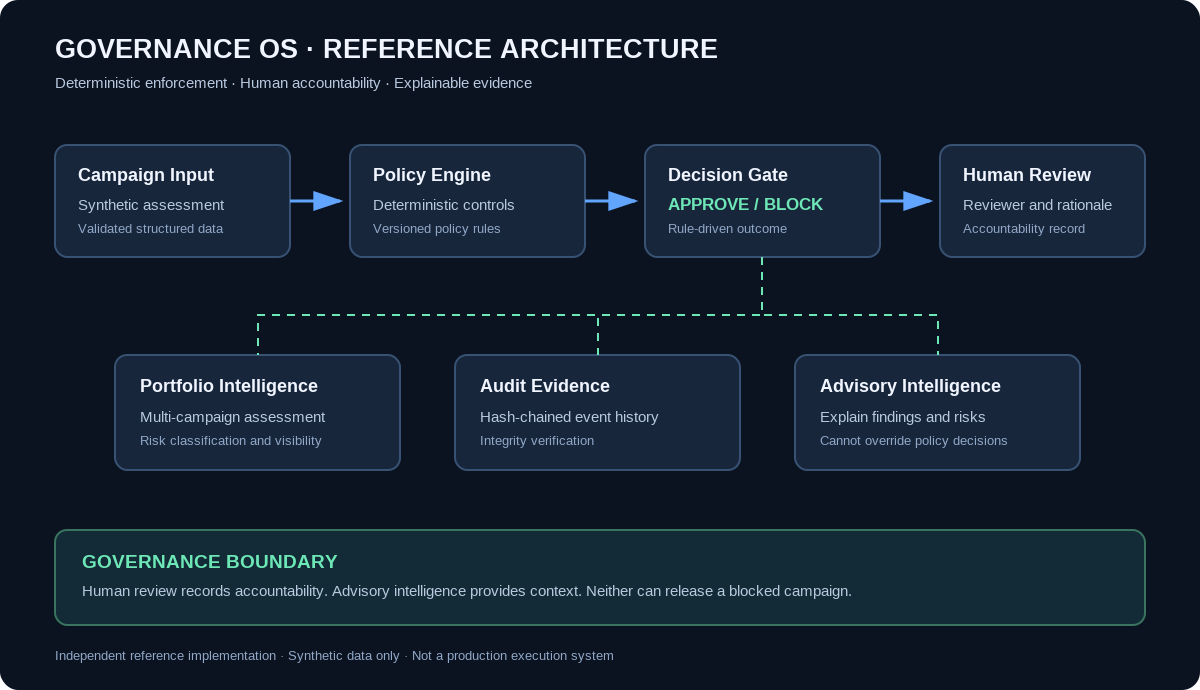
The repository documents deterministic campaign checks; a mandatory FAIL or UNKNOWN yields BLOCK. The advisory investigation layer can explain evidence and recommend diagnostics, but it cannot override the gate. Human review records accountability and does not automatically release a blocked campaign.

Governance OS architecture showing deterministic campaign checks, block outcome, advisory investigation and human review
Existing repository architecture diagram. Open SVG ↗
Illustrative control scenarios

Common failure modes translated into evidence checks

These are synthetic examples, not reported incidents or claims of specific production integrations. They show how an operator might frame a check for evaluation.

Audience or targeting mismatch

Scenario: selected audience differs from the approved baseline or expected targeting criteria.

Control idea: compare the submitted audience evidence with an explicit baseline; flag missing or out-of-policy evidence for BLOCK / review according to configured policy.

Consent or suppression evidence missing

Scenario: the run package lacks current consent or suppression evidence.

Control idea: treat required evidence as mandatory; missing/unknown status must not silently pass.

Broken link or dynamic content proof

Scenario: a link, personalization rule, or rendered content proof has not been checked.

Control idea: require a reviewer-confirmed proof or a documented validation artifact. The project README documents advisory content checks and explicit human proof approval; this page does not claim full link crawling or dynamic-content integration.

Approval bypass or unclear ownership

Scenario: mandatory checks are incomplete or the decision lacks an accountable reviewer.

Control idea: keep FAIL / UNKNOWN blocking, capture reviewer identity, action and rationale, and retain an audit event for later inspection.
Sample decision shape

Readable outcomes

Illustrative display only. The live app evaluates its bundled examples and produces the authoritative result for each run.

APPROVE · synthetic passing example

decision: APPROVE
mandatory_checks: PASS
review:
  action: APPROVE
  reviewer: Example Reviewer
  rationale: "Synthetic evidence reviewed for demo."
execution: not performed

For an actual demo, select the bundled Passing example, run pre-flight, then open Human Review and record an APPROVE action with a rationale.

BLOCK · synthetic blocking example

decision: BLOCK
mandatory_checks: FAIL or UNKNOWN
review:
  available actions: REJECT / REQUEST_CHANGES
execution: not performed

The bundled Blocking example demonstrates the block path. The current app intentionally does not allow a BLOCK result to be approved through its human-review action list.

Try it in under a minute

  1. Open Governance OS and select Campaign QA.
  2. Leave input mode on Bundled example.
  3. Select Blocking example and run pre-flight.
  4. Repeat with Passing example, then go to Human Review and record a demo reviewer, APPROVE, and a short rationale.
  5. Open Audit Ledger to inspect recorded assessment and review events.

The repository source confirms these controls and bundled-example labels. Streamlit may take time to wake when idle.

Evidence and limits

What the repository supports

  • Python validation engine, configurable JSON policy and Streamlit interface.
  • Synthetic pass/block inputs and machine-readable evidence output.
  • Portfolio assessment, human-review recording and local hash-chain verification.
  • Automated tests and GitHub Actions workflow.
  • No production Campaign connection, campaign execution, real recipient data or unrestricted AI override.

Full engineering case study ↗